
Run-Throughs
Blue: The Practice Rainbow, Pt. 6
This week is our sixth in this series Have Fun, Get Better: How to Practice. We’ve talked about The Practice Rainbow, How to Warm-Up, How to Practice Scales, How to Find a Problem Spot, and How to Drill a Problem Spot. Today we get into the thing that you all probably know how to do which is Run-throughs!
A run-through is when you play through a larger section of an entire piece, perform an entire movement, or play an entire work. Run-throughs are great opportunities to zoom out and get a better sense of what is working and what isn’t in your playing. They are especially helpful with appropriate accompaniment played either at concert tempo or a very specific medium tempo.
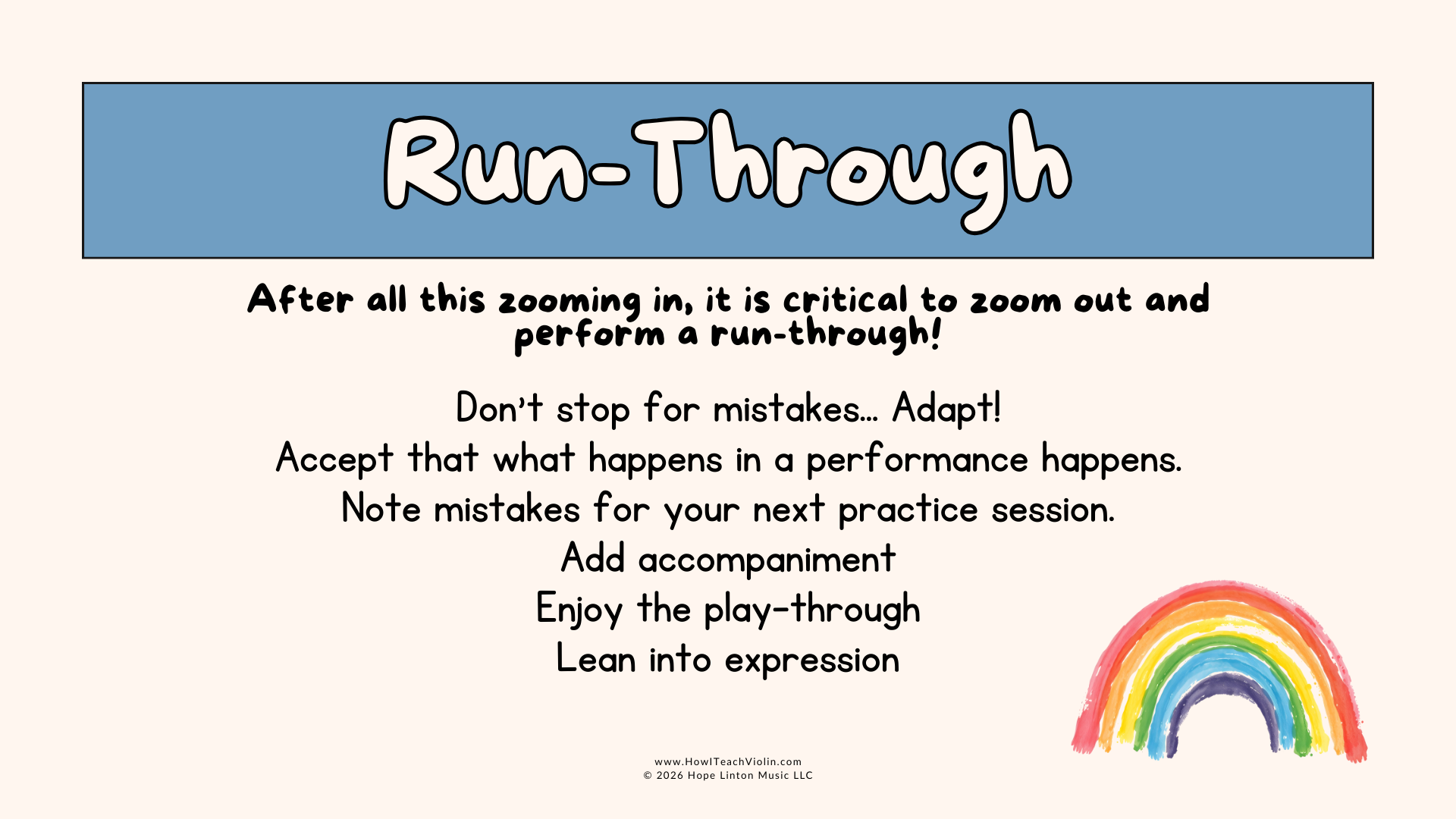
Pre Run-Through
Be clear about how much you’re playing. Is it an entire page or an entire movement? Make sure you have enough time and try to give yourself a distraction-free spot so you’re not interrupted. Phone on silent and away from the music stand tends to be helpful.
The Run-Through
Breathe, keep going. We do not stop for mistakes. We do not go back and fix mistakes now. We play. We adapt when mistakes happen, and we keep going. A run-through reminds me of driving over a very long bridge. We don’t stop for coffee or gas while we are driving over the bridge. We don’t go into reverse. We don’t slow down or speed up a lot. We just keep going and get to the other side. Once we are on the other side, we can look back, reflect and think about how it went and how we want the next run-through to go.

Post Run-Through
Congrats, you did it! Take a moment right at the end of your run-through to scribble things on your part. Grab some tiny post-its and mark the passages that you had trouble counting correctly. It’s like right after you wake up and you want to remember what you dreamed- don’t let anyone interrupt you before you’re able to scribble down the insight you’ve just gotten. It is valuable and worth remembering. We will talk more about this next week with our seventh and final color, Purple/Reflection.
